
Study in Netherlands
The widest English-taught catalogue in Europe, plus the orientation year for graduates.
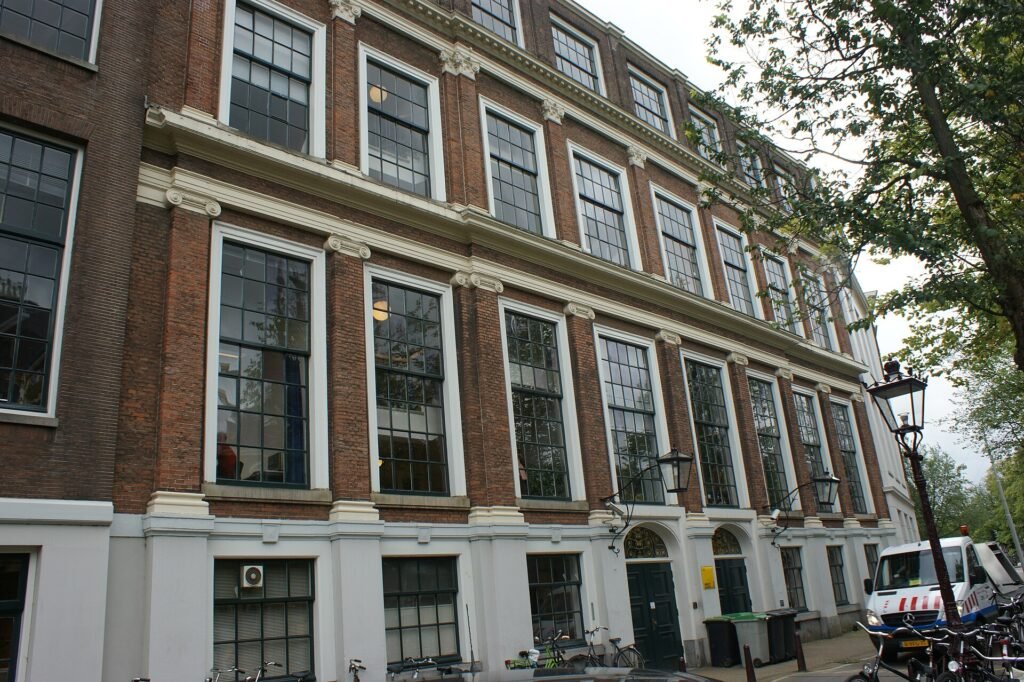
What makes Netherlands worth considering
The Netherlands was one of the first non-English-speaking countries to teach degrees in English at scale, and still has one of the widest English-taught catalogues in Europe. Teaching is problem-based and applied, with strong links to industry.
Huge English-taught choice
More than 2,000 programmes are taught entirely in English.
Problem-based learning
Teaching is applied and discussion-led rather than lecture-only, valued by employers.
Orientation year
Graduates get a 12-month 'zoekjaar' permit to find work, with relaxed employer requirements.
Research universities and UAS
Choose between research universities and applied sciences universities with built-in placements.
English widely spoken
Among the highest English proficiency in continental Europe, making daily life easy.
Well connected
Compact, cycle-friendly cities with excellent rail links across Europe.
Key facts
| Tuition | €8,000–€20,000 per year for non-EU students |
|---|---|
| Living cost | Approximately €900–€1,100 per month |
| Financial proof | Approximately €1,100 per month shown to the university |
| Intakes | September (main) and February (limited) |
| Language | English — IELTS 6.5 typically required |
| Work while studying | 16 hours per week during term, or full-time in summer |
| Post-study stay | 12-month orientation year (zoekjaar) |
| Application portal | Studielink plus university systems |
Popular courses
- Delft University of Technology
- University of Amsterdam
- Eindhoven University of Technology
- Wageningen University
- Erasmus University Rotterdam
- Utrecht University
- Leiden University
- University of Groningen
About Netherlands
Country facts
The Netherlands is a densely populated country of about 18 million people in north-western Europe. Dutch is the official language, though English proficiency is among the highest in the world. Amsterdam is the capital and The Hague hosts the government and international courts.
Higher education system
Dutch higher education is binary: research universities (WO) focused on academic and scientific training, and universities of applied sciences (HBO) offering professional degrees with built-in internships. Both use the Bologna structure and ECTS credits.
Admission requirements
- Relevant bachelor's degree with a good academic record
- IELTS 6.5 overall, some programmes ask 7.0
- GMAT or GRE for selected business and economics master's
- Motivation letter and CV
- Studielink registration alongside the university application
- Numerus fixus programmes have earlier, fixed deadlines
Thinking about Netherlands?
Send us your academic record and budget — we will tell you honestly whether Netherlands is the right fit, and which universities you are competitive for.